#include <Trace.hpp>

Classes | |
| class | TraceStepResult |
Public Types | |
| enum class | StructuralNodePolicy { traceThroughTriviallyInvariant = 0 , traceThroughIfDetectedInvariant = 1 , traceIntoSubregions = 2 } |
Public Member Functions | |
| virtual | ~OutputTracer () |
| OutputTracer () noexcept | |
| StructuralNodePolicy | getStructuralNodePolicy () const noexcept |
| bool | isDeepInvarianceCheckingEnabled () const noexcept |
| bool | isTracingIntoSubregionsEnabled () const noexcept |
| void | setStructuralNodePolicy (StructuralNodePolicy value) noexcept |
| bool | isInterprocedural () const noexcept |
| void | setInterprocedural (bool value) noexcept |
| bool | isEnteringPhiNodes () const noexcept |
| void | setEnterPhiNodes (bool value) noexcept |
| bool | isRegionPredicateCheckingEnabled () const noexcept |
| void | setRegionPredicateCheckingEnabled (bool value) noexcept |
| bool | isInvarianceCachingEnabled () const noexcept |
| void | setInvarianceCaching (bool value) noexcept |
| void | clearInvarianceCache () |
| Output & | trace (Output &output) |
| Output & | trace (Output &output, const Region *withinRegion) |
Protected Types | |
| enum class | BackEdgeState { NoBackEdgeTaken , PossiblyBackEdgeTaken } |
Protected Member Functions | |
| TraceStepResult | traceInternal (Output &output, BackEdgeState backEdgeState, const Region *withinRegion) |
| TraceStepResult | traceGammaOutput (GammaNode &gammaNode, Output &output, BackEdgeState backEdgeState) |
| TraceStepResult | traceThetaOutput (ThetaNode &thetaNode, Output &output, BackEdgeState backEdgeState) |
| TraceStepResult | traceThetaArgument (ThetaNode &thetaNode, Output &output) |
| virtual TraceStepResult | traceStep (Output &output, BackEdgeState backEdgeState, const Region *withinRegion) |
| Output & | insertInInvarianceCache (const Output &structuralOutput, Input &structuralInput) |
| Input * | lookupInInvarianceCache (const Output &structuralOutput) |
Protected Attributes | |
| StructuralNodePolicy | structuralNodePolicy_ |
| bool | isInterprocedural_ = true |
| bool | enterPhiNodes_ = true |
| bool | enableRegionPredicateChecking_ = false |
| AlternativeRegionPredicateTracer | regionPredicateTracer_ |
| const Output * | startingOutput_ = nullptr |
| bool | enableInvarianceCaching_ = false |
| std::unordered_map< const Output *, Input * > | invariantOutputCache_ {} |
Detailed Description
Helper class for tracing through RVSDG graphs to find the origins of outputs. Traces through simple nodes that do not affect the value, through structural nodes when the value is invariant, and out of structural nodes when the value is passed in.
It supports caching of traced values at gamma and theta outputs to avoid the retracing of a value through these structural nodes.
Member Enumeration Documentation
◆ BackEdgeState
|
strongprotected |
◆ StructuralNodePolicy
Different policies for how to handle outputs of structural nodes during tracing. The policies are numbered such that a greater number means more effort is spent.
These policies only apply to gamma and theta nodes. For phi nodes, see isEnteringPhiNodes()
| Enumerator | |
|---|---|
| traceThroughTriviallyInvariant | |
| traceThroughIfDetectedInvariant | |
| traceIntoSubregions | |
Constructor & Destructor Documentation
◆ ~OutputTracer()
|
virtualdefault |
◆ OutputTracer()
|
noexcept |
Creates an OutputTracer with the default configuration
Member Function Documentation
◆ clearInvarianceCache()
|
inline |
Clears the invariance cache.
This only needs to done if invariance caching is enabled.
- See also
- isInvarianceCachingEnabled()
It only needs to be done if either of the following happens:
- structural outputs that were once invariant have their origin changed inside the structural node to make them no longer be invariant, or be invariant copies of a different structural input.
- structural input and outputs are removed from the graph.
◆ getStructuralNodePolicy()
|
inlinenoexcept |
When tracing reaches the output of a structural node, how should the tracer continue.
- See also
- StructuralNodePolicy
- Returns
- the current structural node policy
◆ insertInInvarianceCache()
|
protected |
Inserts the given structuralOutput in the invariance cache. Invariance means that the structural output gets its value from one of the inputs of the structural node, so tracing can pass through the structural node without looking inside its subregions.
When determining invariance, it is important to not makse assumptions about tracing never having followed back-edges.
- Parameters
-
structuralOutput The structural output that was traced. structuralInput The corresponding structural input.
- Returns
- The origin of
structuralInputfor convenience.
◆ isDeepInvarianceCheckingEnabled()
|
inlinenoexcept |
Checks if the current StructuralNodePolicy allows checking for invariant outputs of structural nodes by performing tracing inside the subregion(s) of the node.
- Returns
- true if the policy allows deep invariance checking, false otherwise
◆ isEnteringPhiNodes()
|
inlinenoexcept |
Controls if tracing is allowed to enter the subregion of a phi node from its outputs. If true, tracing can go further and reach lambda or delta nodes inside of phi nodes. It does, however, mean that the result of tracing can end up inside a region that is not an ancestor of the starting region in the region tree.
- Returns
- true if tracing may enter phi nodes.
◆ isInterprocedural()
|
inlinenoexcept |
◆ isInvarianceCachingEnabled()
|
inlinenoexcept |
Controls whether caching of structural output invariance is enabled, which can speed up tracing through deeply nested graphs.
It only caches outputs that are confirmed to be invariant, so outputs that change from variant to invariant will still be picked up. Outputs that change from invariant to variant need to trigger a manual cache invalidation.
- See also
- clearInvarianceCache().
- Returns
- true if structutal output invariance is cached, false otherwise.
◆ isRegionPredicateCheckingEnabled()
|
inlinenoexcept |
◆ isTracingIntoSubregionsEnabled()
|
inlinenoexcept |
Checks if the current StructuralNodePolicy allows tracing to enter subregions, and returning value origins that are inside subregions or sibling regions of the region where tracing started.
- Returns
- true if the policy allows tracing to enter subregions, false otherwise.
◆ lookupInInvarianceCache()
◆ setEnterPhiNodes()
Enables or disables tracing into phi nodes from the outside.
- See also
- isEnteringPhiNodes()
- Parameters
-
value the new value
◆ setInterprocedural()
Enables or disables interprocedural tracing.
- See also
- isInterprocedural()
- Parameters
-
value the new value
◆ setInvarianceCaching()
Enables or disables invariant structural output caching.
- See also
- isInvarianceCachingEnabled()
- Parameters
-
value the new value
◆ setRegionPredicateCheckingEnabled()
◆ setStructuralNodePolicy()
|
inlinenoexcept |
◆ trace() [1/2]
◆ trace() [2/2]
Traces from the given output to find the source of the output's value. The optional parameter withinRegion prevents values from being traced out of the region. If withinRegion is a nullptr, the tracing will continue until the output no longer changes.
- Parameters
-
output the output to trace from. withinRegion the region where we stop tracing.
◆ traceGammaOutput()
|
protected |
Trace from the given gamma output. If the gamma output can be traced to the same gamma input in all subregions, the origin of the gamma input is returned. Otherwise, if the tracer is allowed to trace into subregions, and only one of the subregions can be the origin of the value being traced, the origin within that subregion is returned. Otherwise, the gamma output itself is returned.
- Precondition
- the
outputis an output of the givengammaNode
- Parameters
-
gammaNode the gamma node to trace through output an output of the given gamma node backEdgeState enum describing the path taken from the starting output to output.
- Returns
- the result of tracing from the gamma output
◆ traceInternal()
|
protected |
Performs tracing from the given output, without updating the current starting output. Keeps tracing until the tracer is unable to find a more canonical output, or until an argument of the optional withinRegion limit is reached.
- Parameters
-
output the output to trace from. backEdgeState enum describing the path taken from the starting output to output.withinRegion the region tracing has to stay within, or nullptr
- Returns
- the end result of tracing, either a final output, or an impossible origin.
◆ traceStep()
|
protectedvirtual |
The innermost body of the tracing loop. Should trace at least one step, if possible. If it is not possible to trace further, the same output is returned.
- Parameters
-
output the output to trace from. backEdgeState enum describing the path taken from the starting output to output.withinRegion if not nullptr, tracing stops if it reaches an argument of the region.
- Returns
- the result of tracing from the given output
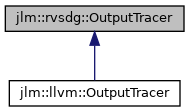
Reimplemented in jlm::llvm::OutputTracer.
◆ traceThetaArgument()
|
protected |
Trace from the given loop variable pre argument. This function is only used when the tracing starting point is inside the theta.
- Precondition
- the
outputis an argument of the giventhetaNode'ssubregion.
- Parameters
-
thetaNode the theta node to attempt to trace out of output the theta subregion argument
- Returns
- the result of tracing from the theta argument
◆ traceThetaOutput()
|
protected |
Trace from the the given loop output. If the loop output is found to be loop invariant, the origin of the theta input is returned. Otherwise, if the tracer is allowed to trace into the subregion of structural nodes, the traced origin of the loop variable post inside the theta is returned. Otherwise, the theta output itself is returned.
- Precondition
- the
outputis an output of the giventhetaNode
- Parameters
-
thetaNode the theta node to trace through output an output of the given theta node backEdgeState enum describing the path taken from the starting output to output.
- Returns
- the result of tracing from the theta output
Member Data Documentation
◆ enableInvarianceCaching_
◆ enableRegionPredicateChecking_
◆ enterPhiNodes_
◆ invariantOutputCache_
◆ isInterprocedural_
◆ regionPredicateTracer_
|
protected |
◆ startingOutput_
◆ structuralNodePolicy_
|
protected |
The documentation for this class was generated from the following files: