Invariant Value Redirection. More...
#include <InvariantValueRedirection.hpp>
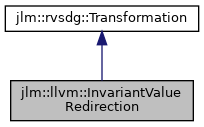
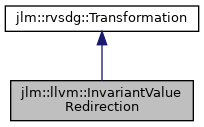
Classes | |
| struct | Configuration |
| class | Statistics |
Public Member Functions | |
| ~InvariantValueRedirection () override | |
| InvariantValueRedirection (Configuration configuration) | |
| void | Run (rvsdg::RvsdgModule &module, util::StatisticsCollector &statisticsCollector) override |
| Perform RVSDG transformation. | |
 Public Member Functions inherited from jlm::rvsdg::Transformation Public Member Functions inherited from jlm::rvsdg::Transformation | |
| virtual | ~Transformation () noexcept |
| Transformation (std::string_view Name) | |
| const std::string_view & | GetName () const noexcept |
| void | Run (RvsdgModule &module) |
| Perform RVSDG transformation. | |
Static Public Member Functions | |
| static void | createAndRun (rvsdg::RvsdgModule &rvsdgModule, Configuration configuration) |
Private Member Functions | |
| void | redirectInRootRegion (rvsdg::Graph &rvsdg) |
| void | redirectInRegion (rvsdg::Region ®ion) |
| void | redirectInSubregions (rvsdg::StructuralNode &structuralNode) |
Static Private Member Functions | |
| static void | redirectGammaOutputs (rvsdg::GammaNode &gammaNode) |
| static void | redirectGammaOutputConstants (rvsdg::GammaNode &gammaNode) |
| static void | redirectThetaOutputs (rvsdg::ThetaNode &thetaNode) |
| static void | redirectThetaGammaOutputs (rvsdg::ThetaNode &thetaNode) |
| static void | redirectCallOutputs (rvsdg::SimpleNode &callNode) |
| static void | redirectLoadMemoryStates (rvsdg::SimpleNode &loadNode) |
Private Attributes | |
| Configuration | configuration_ {} |
Detailed Description
Invariant Value Redirection.
Invariant Value Redirection (IVR) redirects invariant edges around gamma, theta, call, and load nodes. It does this by diverting all users of invariant outputs to the origin of the respective inputs. In case of nested nodes, the transformation processes the innermost nodes first to ensure that the outputs of outer nodes are correctly identified as invariant. Moreover, IVR processes a lambda node before all the lambda's call nodes to ensure that the outputs of call nodes are correctly identified as invariant. Nodes that become dead throughout the transformation are pruned from a region.
Gamma output redirection
The output of a gamma node is considered invariant if all the corresponding region results are connected to the arguments of a single gamma input. All the users of a gamma output are diverted to the origin of this gamma input.
Gamma output constant redirection
The output of a gamma node is considered invariant if all the corresponding region results are connected to constants that represent the same value. This can include UndefValueOperation constants, which can be used as a replacement for any constants. All the users of a gamma output are diverted to a respective constant node that is created in the parent region of the gamma node.
Theta output redirection
A loop variable is considered invariant if its post value is connected to its corresponding pre value. All the users of the loop variables' output are diverted to the origin of the corresponding input. See rvsdg::ThetaLoopVarIsInvariant() for more details.
Theta/gamma correlation redirection
If the theta node has a gamma node in its subregion and for both nodes the predicates correlate, then the theta node's loop variables can be redirected under certain conditions. The correlation of predicates means that either:
- The theta node's predicate origin is an exit variable of the gamma node and the respective producers of the subregion results are control constants.
- The producer of the theta node's predicate origin and the gamma node's predicate origin are the same rvsdg::MatchOperation node.
These conditions are sufficient to statically determine that either one of the two gamma node's subregions is only executed on loop repetition or loop exit.
A loop variable can now be redirected in the following cases:
- If the loop variable's output is dead, then only the repetition value of the loop variable is of interest. This means that we can redirect the value from the respective entry variable of the gamma node's repetition subregion to the post value.
- If the loop variable's pre value is dead, then only the exit value of the loop variable is of interest. This means that we can redirect the value from the respective entry variable of the gamma node's exit subregion to the post value.
Call output redirection
The output of a call node is considered invariant if the respective result of the corresponding lambda is connected to an argument of the lambda. All the users of a call output are diverted to the origin of the call input corresponding to the lambda argument. Invariant Value Redirection for call nodes works only on non-recursive direct calls as IVR needs to inspect the lambda body in order to determine whether a value is simply routed through the lambda.
Load memory state redirection
The memory states of a load node can be diverted to their respective input's origin if the loaded value output of the load node is dead.
Definition at line 88 of file InvariantValueRedirection.hpp.
Constructor & Destructor Documentation
◆ ~InvariantValueRedirection()
|
overridedefault |
◆ InvariantValueRedirection()
|
inlineexplicit |
Definition at line 105 of file InvariantValueRedirection.hpp.
Member Function Documentation
◆ createAndRun()
|
static |
Creates an instance of InvariantValueRedirection and invokes its Run() method.
- Parameters
-
rvsdgModule The RVSDG on which invariant value redirection is invoked on. configuration The configuration for the instance.
Definition at line 72 of file InvariantValueRedirection.cpp.
◆ redirectCallOutputs()
|
staticprivate |
Definition at line 412 of file InvariantValueRedirection.cpp.
◆ redirectGammaOutputConstants()
|
staticprivate |
Definition at line 208 of file InvariantValueRedirection.cpp.
◆ redirectGammaOutputs()
|
staticprivate |
Definition at line 196 of file InvariantValueRedirection.cpp.
◆ redirectInRegion()
|
private |
Definition at line 125 of file InvariantValueRedirection.cpp.
◆ redirectInRootRegion()
|
private |
Definition at line 82 of file InvariantValueRedirection.cpp.
◆ redirectInSubregions()
|
private |
Definition at line 183 of file InvariantValueRedirection.cpp.
◆ redirectLoadMemoryStates()
|
staticprivate |
Redirects the load node's users of the memory state outputs to the origins' of the respective memory state inputs, if the value output of the load node is dead.
- Parameters
-
loadNode The load node for which the memory states are redirected.
Definition at line 532 of file InvariantValueRedirection.cpp.
◆ redirectThetaGammaOutputs()
|
staticprivate |
Redirects invariant loop variables from theta nodes of which thet predicate statically correlates with the predicate of a gamma node.
- Parameters
-
thetaNode The rvsdg::ThetaNode of which the loop variables are redirected.
Definition at line 347 of file InvariantValueRedirection.cpp.
◆ redirectThetaOutputs()
|
staticprivate |
Definition at line 325 of file InvariantValueRedirection.cpp.
◆ Run()
|
overridevirtual |
Perform RVSDG transformation.
- Note
- This method is expected to be called multiple times. An implementation is required to reset the objects' internal state to ensure correct behavior after every invocation.
- Parameters
-
module RVSDG module the transformation is performed on. statisticsCollector Statistics collector for collecting transformation statistics.
Implements jlm::rvsdg::Transformation.
Definition at line 58 of file InvariantValueRedirection.cpp.
Member Data Documentation
◆ configuration_
|
private |
Definition at line 162 of file InvariantValueRedirection.hpp.
The documentation for this class was generated from the following files:
- jlm/llvm/opt/InvariantValueRedirection.hpp
- jlm/llvm/opt/InvariantValueRedirection.cpp