#include <hls.hpp>
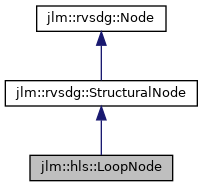
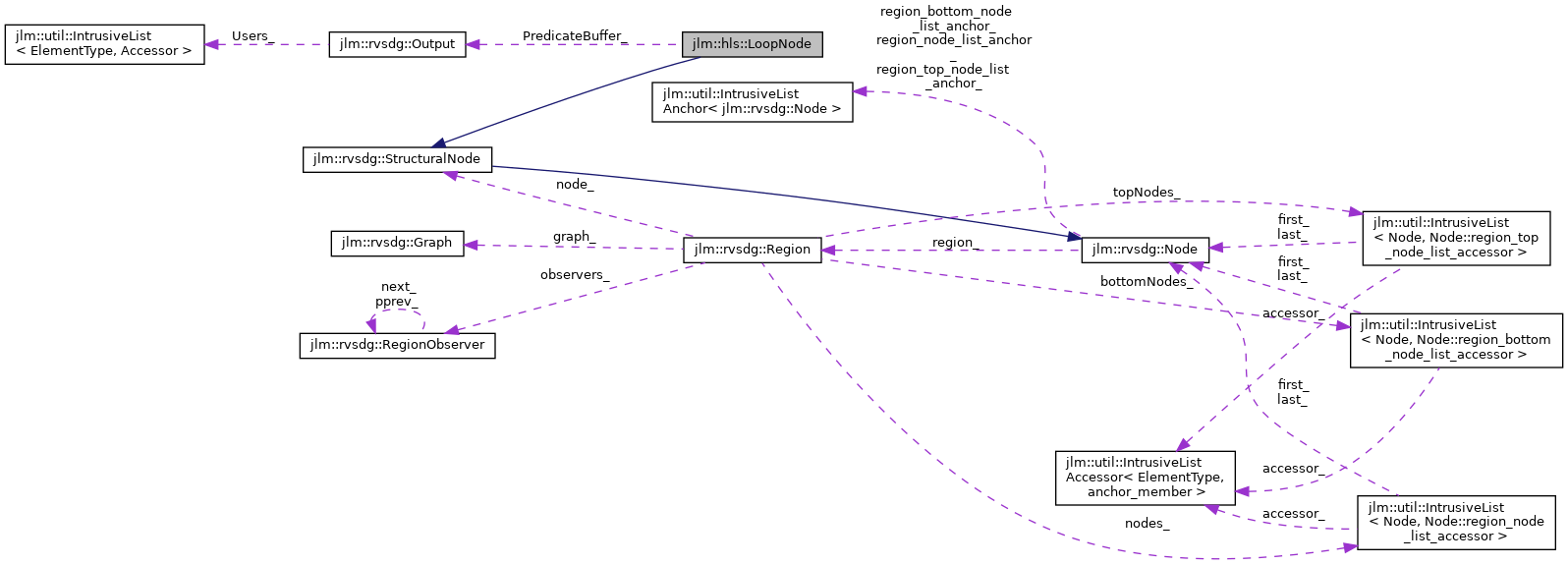
Classes | |
| struct | BackEdgeVar |
| Variable passed between hls loop iterations. More... | |
| struct | EntryVar |
| Variable entering the hls loop. More... | |
| struct | ExitVar |
| Variable exiting the hls loop. More... | |
 Public Member Functions inherited from
 Static Public Member Functions | |
| static LoopNode * | create (rvsdg::Region *parent) |
Private Member Functions | |
| LoopNode (rvsdg::Region *parent) | |
Private Attributes | |
| rvsdg::Output * | PredicateBuffer_ {} |
Detailed Description
Constructor & Destructor Documentation
◆ ~LoopNode()
|
overridedefaultnoexcept |
◆ LoopNode()
|
inlineexplicitprivate |
Member Function Documentation
◆ add_backedge()
| BackEdgeArgument * jlm::hls::LoopNode::add_backedge | ( | std::shared_ptr< const jlm::rvsdg::Type > | type | ) |
◆ addLoopConstant()
| jlm::rvsdg::Output * jlm::hls::LoopNode::addLoopConstant | ( | rvsdg::Output * | origin | ) |
◆ AddLoopVar()
| rvsdg::StructuralOutput * jlm::hls::LoopNode::AddLoopVar | ( | rvsdg::Output * | origin, |
| rvsdg::Output ** | buffer = nullptr |
||
| ) |
Creates a loop-carried variable for this LoopNode.
Creates a node input for the initial loop variable, which takes the origin as its value. Inside the loop region, a corresponding EntryArgument is created. A back-edge is also created, by adding a BackEdgeResult and corresponding BackEdgeArgument. Lastly an ExitResult with a corresponding node output is created.
At the top of the loop region, a MuxOperation predicated on the loop predicate buffer is used to pick between the EntryArgument and the BackEdgeArgument.
At the bottom of the region, a BranchOperation predicated on the loop predicate is used to send the result to an ExitResult when the loop is done, or to the BackEdgeResult if not. The BackEdgeResult has a small non-passthrough buffer in front of it, to break cycles.
- Parameters
-
origin the initial value, defined outside the loop buffer if non-null, will be set to a pointer to the Mux output.
- Returns
- the created node output that yields the variable's value when the loop exits
◆ addRequestOutput()
| rvsdg::Output * jlm::hls::LoopNode::addRequestOutput | ( | rvsdg::Output * | origin | ) |
Creates a node output / region result pair for sending requests out of the loop body. This output behaves as an escape hatch, and does not follow standard RVSDG semantics.
- Parameters
-
origin the origin of the request inside the loop
- Returns
- the created node output
◆ addResponseInput()
| rvsdg::Output * jlm::hls::LoopNode::addResponseInput | ( | rvsdg::Output * | origin | ) |
Creates an input / region argument pair for sending responses into the loop body. This input behaves as an escape hatch, and does not follow standard RVSDG semantics.
- Parameters
-
origin the origin of the response outside the loop
- Returns
- the created EntryArgument inside the loop region
◆ copy()
|
overridevirtual |
Copy a node with substitutions.
- Parameters
-
region Target region to create node in smap Operand substitutions
- Returns
- Copied node
Create a new node that is semantically equivalent to an existing node. The newly created node will use the same operands as the existing node unless there is a substitution registered for a particular operand.
The given substitution map is updated so that all outputs of the original node will be substituted by corresponding outputs of the newly created node in subsequent copy operations.
Implements jlm::rvsdg::Node.
◆ create()
|
static |
◆ getBackEdgeVars()
| std::vector< LoopNode::BackEdgeVar > jlm::hls::LoopNode::getBackEdgeVars | ( | ) |
◆ getEntryVars()
| std::vector< LoopNode::EntryVar > jlm::hls::LoopNode::getEntryVars | ( | ) |
◆ getExitVars()
| std::vector< LoopNode::ExitVar > jlm::hls::LoopNode::getExitVars | ( | ) |
◆ GetOperation()
|
overridevirtualnoexcept |
Implements jlm::rvsdg::Node.
◆ GetPredicateBuffer()
|
inlinenoexcept |
◆ mapArgument()
| std::variant< LoopNode::EntryVar, LoopNode::BackEdgeVar > jlm::hls::LoopNode::mapArgument | ( | const rvsdg::Output & | argument | ) |
◆ mapInput()
| LoopNode::EntryVar jlm::hls::LoopNode::mapInput | ( | const rvsdg::Input & | input | ) |
◆ mapOutput()
| LoopNode::ExitVar jlm::hls::LoopNode::mapOutput | ( | const rvsdg::Output & | output | ) |
◆ mapResult()
| std::variant< LoopNode::ExitVar, LoopNode::BackEdgeVar > jlm::hls::LoopNode::mapResult | ( | const rvsdg::Input & | result | ) |
◆ predicate()
|
inlinenoexcept |
◆ removeBackEdgeVars()
| void jlm::hls::LoopNode::removeBackEdgeVars | ( | std::vector< BackEdgeVar > | vars | ) |
◆ removeEntryVars()
◆ removeExitVars()
◆ set_predicate()
| void jlm::hls::LoopNode::set_predicate | ( | jlm::rvsdg::Output * | p | ) |
◆ subregion()
|
inlinenoexcept |
Member Data Documentation
◆ PredicateBuffer_
|
private |
The documentation for this class was generated from the following files: